
School-based health centers
A fixed exam room in the school with a telemedicine cart or kit, run by the center’s nurse or medical assistant, with the provider joining from the sponsoring clinic or hospital.
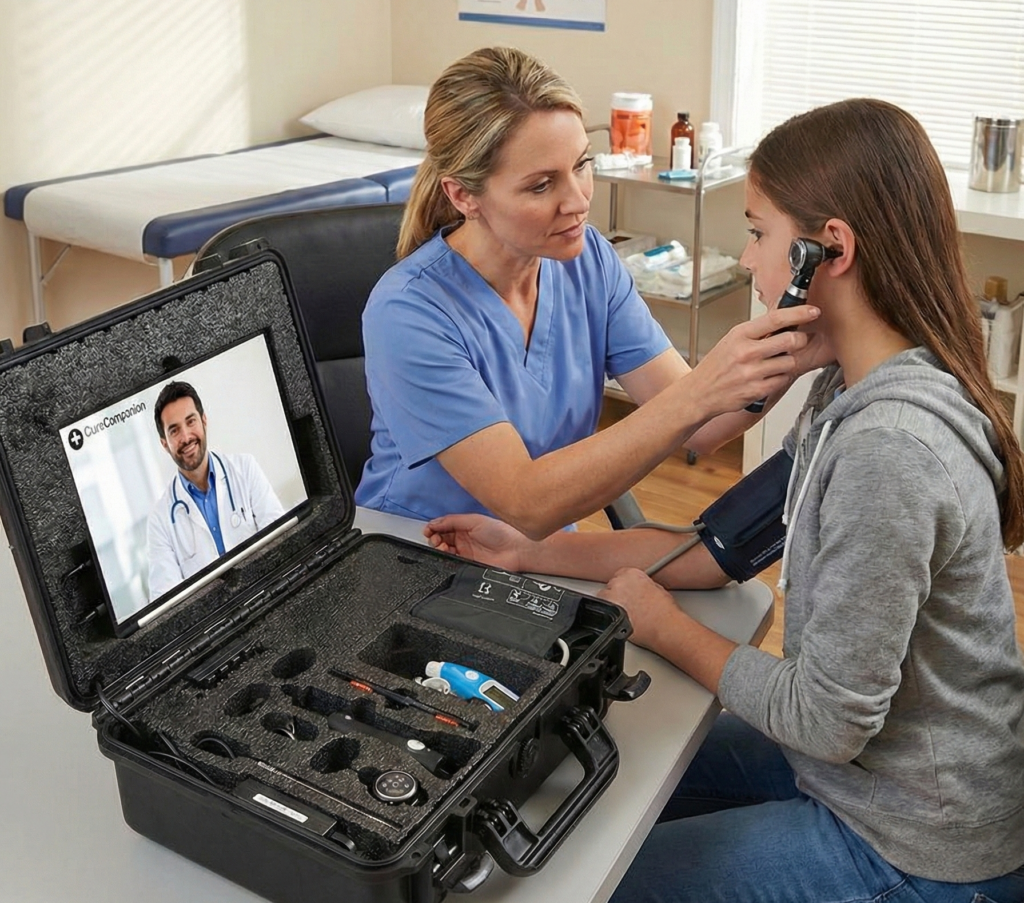
Telemedicine cart →CureCompanion equips schools with essential telehealth hardware and software, allowing the school nurse to consult healthcare providers virtually. Going beyond just video-based telehealth, our solutions include specialized medical devices and equipment which let healthcare providers do more in-depth telemedicine: examine the student’s skin, eyes, ears, and throat, listen to heart and lung sounds, and get vitals and diagnostics.




CureCompanion provides cost-effective telehealth equipment and software which is optimized for low-resource settings and highly rated by providers and schools.
We work with schools and provider groups across the United States, whether privately funded or applying via a state/federal grant.
A fixed exam room in the school with a telemedicine cart or kit, run by the center’s nurse or medical assistant, with the provider joining from the sponsoring clinic or hospital.
Telemedicine cart →A telemedicine kit in the nurse’s office: the school nurse connects a student to a provider during the school day, with ears, throat, lungs, and vitals examined on the spot.
Telemedicine kit →Kits across several campuses on one software license and one patient record, with your district’s partner pediatric or primary care group seeing the students.
Telehealth software platform →Rural school-based telehealth programs can be funded through state Rural Health Transformation Program sub-awards and USDA Distance Learning and Telemedicine grants; we supply the quotes and specifications the application needs.
Rural Health Transformation Program →Students stay at school for the visit instead of missing class, and parents are not pulled from work for a drive to the clinic.
CureCompanion’s telehealth technology bridges the gap in healthcare access by connecting students with healthcare providers virtually. For communities and settings with limited access to care, our integrated hardware and software solutions enable comprehensive virtual examinations. Using our medical devices, including HD cameras, digital stethoscope, vitals devices, and more, providers can conduct thorough assessments remotely, eliminating the need for students to miss school or forgo essential healthcare.
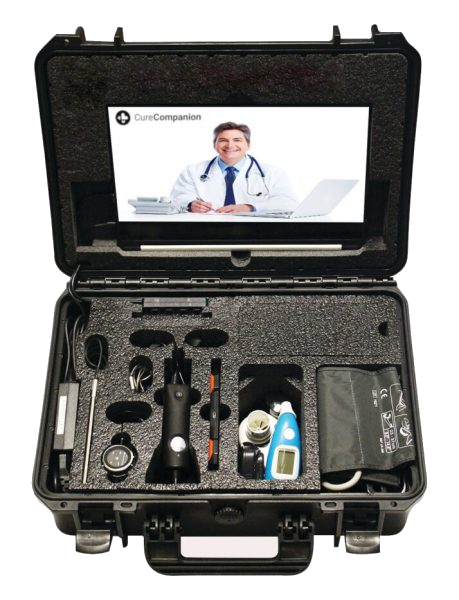
The school nurse’s kit: 14-inch touchscreen tablet, 1080p HD webcam, IP-67 rated hard case, 8+ hour battery, about 20 lbs, so it moves between campuses.
Nine integrated medical devices: stethoscope, exam camera, otoscope, 12-lead ECG, blood pressure monitor, pulse oximeter, spirometer, glucometer, thermometer
Connects to the school’s Wi-Fi; no dedicated circuit or static IP
Arrives pre-connected, configured, and tested, with remote training for the nurse
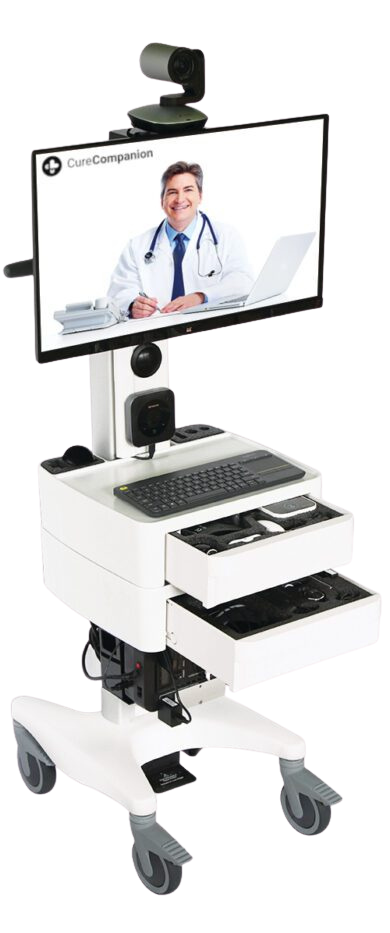
For a fixed school-based health center exam room: 27-inch 1080p display, pan-tilt-zoom HD camera with far-end control, conference-grade audio, medical-grade battery backup (UPS).
Pneumatic height adjustment for students of every age
Nine integrated medical devices, configured per program
Video-only configuration available for tele-specialty programs
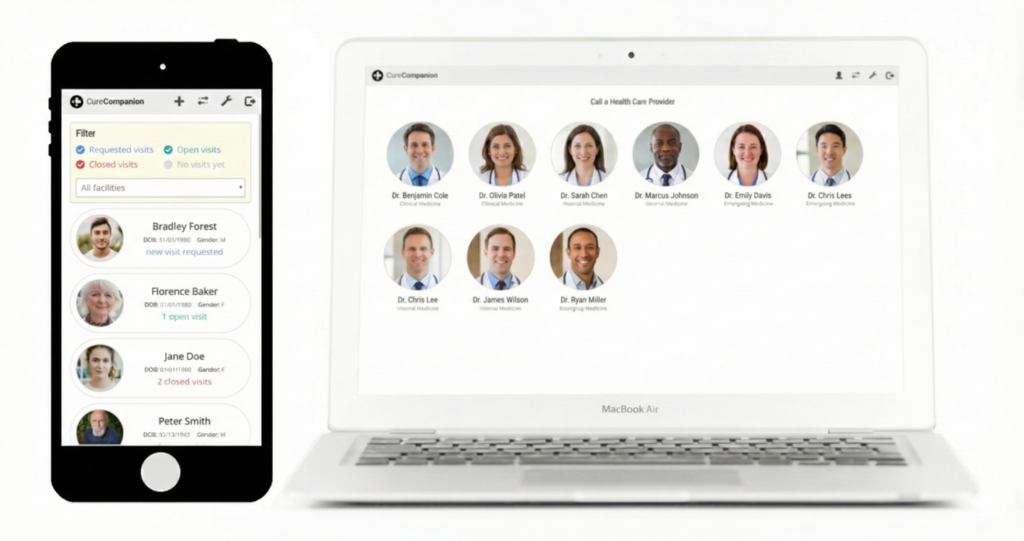
One HIPAA-compliant platform for visits, records, and AI documentation; the same software across kits and carts.
HD video visits on web, iOS, and Android for the provider
One-touch device switching; Bluetooth vitals recorded with no manual entry
EHR integration via SMART on FHIR; white label option
Devices by brand: Riester digital stethoscope, Firefly Global video otoscope, SHL Telemedicine 12-lead ECG, A&D Medical blood pressure monitor, Nonin pulse oximeter, and Vitalograph spirometer, plus a handheld exam camera, professional glucometer, and non-contact thermometer. Device makes and models are representative configurations and may be substituted with equal or better specifications. We integrate third-party devices; we do not manufacture them. All telehealth equipment and devices →
With a basic video call, the provider depends on the student’s description. With CureCompanion’s integrated devices, the provider examines, listens, and measures through the school nurse.
The school nurse calls the provider using our software platform. The provider sees and talks to the student using their own iOS/Android mobile device, laptop, or PC.
The provider examines the student’s skin, eyes, ears, and throat virtually using HD cameras.
The provider listens to the student’s heart and lung sounds virtually in real-time.
The nurse records the student’s vitals wirelessly using our Bluetooth medical devices. The provider reviews them before/while talking to the student.
The provider reviews symptoms and past medical history entered by the nurse.
Ambient listening drafts the progress note from the visit conversation, and facility-defined post-visit assessments can track outcomes such as school attendance.
Sore throat
The student says it hurts; the nurse describes the throat.
The exam camera and otoscope show the throat and tonsils live to the provider.
Ear pain
Not examinable; a clinic visit is scheduled and the student goes home.
The video otoscope streams the ear canal and eardrum in HD, during the school day.
Rash and skin
A webcam view in classroom lighting.
The nurse holds the exam camera, with adjustable LEDs and close focus.
Asthma and lung sounds
The student reports how breathing feels.
The digital stethoscope streams lung sounds; the spirometer records lung function over Bluetooth.
Vital signs
Taken by hand and read aloud.
Temperature, pulse oximetry, and blood pressure sync into the record over Bluetooth.
The provider is your school’s own partner clinic, pediatric group, or school-based health center; CureCompanion provides the technology and trains the nurse remotely in 60 to 90 minutes.
Enhanced quality of care with AI. Our software features innovative AI enhancements which transform quality of telehealth care, on the same platform that runs the kit, the cart, and the video visit.
Encrypted video visits from a browser on any device, or from the iOS and Android apps.
One-touch device switching: activate the stethoscope, otoscope, or exam camera and the software detects it and streams it to the provider.
Bluetooth vitals write into the student’s record without manual entry.
Patient records, visit notes, and progress notes in one place; the same software across kits and carts.
EHR integration via SMART on FHIR; white label option for your program’s name.
AI documentation that drafts the note from the visit conversation, and facility-defined post-visit assessments, available on the platform.
HIPAA compliant with a Business Associate Agreement: AES-256 encryption at rest, TLS 1.2+ in transit, access controls, audit logging, and automated daily backups.
During telehealth visits, our ambient listening AI system passively listens to provider-patient conversations, generates complete documentation, and tracks important outcomes.
Available on the platformOur AI can be configured to track key quality metrics, which can help schools measure and improve school attendance.
Workflows are modeled on in-person visits. Remote training runs 60 to 90 minutes per team, with refreshers available, and the provider is your own partner clinic or group.
A telemedicine kit per campus or a cart in the school-based health center is a common equipment line in school telehealth grant budgets. We work with schools and provider groups across the United States, whether privately funded or applying via a state/federal grant.
Delivery
The kit or cart arrives pre-connected, configured, and tested, typically 4 to 6 weeks after order.
Training
Remote, 60 to 90 minutes for the school nurse or health center team, with refreshers available.
Network and power
About 1 Mbps per visit, 4 to 5 Mbps recommended, on the school’s Wi-Fi. Standard outlet; no dedicated circuit or static IP.
Warranty and support
12-month warranty, with email and phone support.
Ownership
Hardware is purchased outright with no recurring hardware charges. Software is licensed per organization, not per kit or per user, so a district covers every campus under one license.
State and federal grants. School-based health center grants, state telehealth and school health programs, and foundation awards look for a sustainable program and equipment that keeps working after the grant ends: hardware owned outright and one software license per organization.
Rural Health Transformation Program (RHTP). States are funding telehealth projects with CMS’s five-year program, and rural school-based telehealth can be part of a sub-award. How we fulfill RHTP telehealth, RPM, and AI expectations →
USDA Distance Learning and Telemedicine (DLT). DLT grants have funded school-based telehealth equipment for years; we have responded to DLT equipment bids and delivered carts and kits to DLT grant recipients, with the itemized quotes, specification sheets, and equipment descriptions a budget justification needs.
Itemized quotes and specification sheets in the format your application requires
Equipment descriptions and budget-justification language
Pricing held through your grant cycle
Sustainability framing for reviewers: outright hardware purchase and one software license per organization
Non-debarment attestation and W-9 on request
Telehealth equipment and software from Austin, Texas, built for low-resource settings.
Customers in 20+ states and 12+ countries, including school-based health centers and the provider groups behind them.
Vendor to USDA DLT grant recipients, state telehealth grants, and RHTP-funded programs.
Hardware, software, 12-month warranty, remote training, and support from one accountable vendor.
The questions school nurses, districts, and school-based health centers ask before they request a quote.
School-based telehealth connects a student at school with a healthcare provider somewhere else, with the school nurse at the student’s side. With CureCompanion’s integrated devices the provider does more than talk: they look in the ears and throat, listen to the heart and lungs, and read vitals, so many minor-illness visits finish without the student leaving school.
A telemedicine kit covers most schools: a touchscreen tablet, HD webcam, video otoscope, exam camera, digital stethoscope, and Bluetooth vitals devices in a 20 lb hard case, on software that puts them in one visit and one record. A school-based health center with a fixed exam room may prefer a telemedicine cart.
The school nurse or the school-based health center’s medical assistant. Workflows are modeled on in-person visits; training is remote and takes 60 to 90 minutes, with refreshers available.
Your own: the district’s partner clinic, pediatric or primary care group, or the school-based health center’s sponsoring organization. CureCompanion provides the technology and does not supply clinicians.
Yes. The kit weighs about 20 lbs, runs 8+ hours on battery, and connects to each school’s Wi-Fi, so a nurse or health team can move it between campuses. The software is licensed per organization, so every campus is covered under one license.
Yes. Video, images, sounds, and readings travel through the CureCompanion platform, which is HIPAA compliant: encryption in transit (TLS 1.2+) and at rest (AES-256), access controls, audit logging, automated daily backups, and a Business Associate Agreement with the organization that provides the care.
About 1 Mbps per concurrent visit, with 4 to 5 Mbps recommended, over the school’s existing Wi-Fi. No dedicated circuit, static IP, or special network equipment is required.
School-based health center grants, state telehealth and school health programs, USDA DLT grants, and, for rural schools, state Rural Health Transformation Program sub-awards have all funded telehealth equipment. Eligibility and allowable costs are decided by the program and your state; we supply the quotes and specifications your application needs. Our RHTP telehealth, RPM, and AI guide →
A kit for a nurse’s office or a program that moves between campuses; a cart for a school-based health center with a dedicated exam room, where the pan-tilt-zoom camera, the large display, and height adjustment earn their place. Both run on the same software.
It depends on the configuration: kit or cart, the devices in it, and how many campuses. Hardware is purchased outright with no recurring hardware charges, and the software is licensed per organization rather than per kit or per user. Request a quote and we will itemize a configuration for your program and budget.
Tell us your campuses, who your providers are, and whether you are applying for a grant. We reply with:
An itemized quote and specification sheet for kits, carts, and the software
Budget-justification language for grant applications
A live demo of a school telehealth visit, with the devices streaming
Lead time and a training plan for your school nurses
Prefer to talk? Call (512) 967-0664 or email contact@curecompanion.com.