
Rural Health Transformation Program (RHTP): Telehealth, Remote Patient Monitoring, and AI on One Platform
Telemedicine carts and kits, remote patient monitoring home kits, and AI documentation on one HIPAA-compliant platform from one vendor: one contract, one BAA, one login, one patient record, one support line, and equipment you own after the grant ends. We supply equipment and software to RHTP-funded programs, USDA DLT grant recipients, and state telemedicine grants.



What the Rural Health Transformation Program funds
The Rural Health Transformation (RHT) Program, usually written RHTP, is a $50 billion CMS program created by the 2025 reconciliation law: $10 billion in each of federal fiscal years 2026 through 2030, half split equally among the states and half allocated by CMS. All 50 states received first-year awards in December 2025 and now sub-award to rural hospitals, clinics, FQHCs, rural health clinics, EMS agencies, and other providers. Many of those sub-awards fund telehealth, remote patient monitoring, and AI projects.
$50B
$10B
50 states
The ten statutory uses, and the four a telehealth, RPM, and AI platform fulfills
The statute lists ten allowable uses of funds, (A) through (J), and every state plan must carry at least three. Four of them are what a telehealth, remote patient monitoring, and AI platform delivers.
(A) “Promoting evidence-based, measurable interventions to improve prevention and chronic disease management.”
RPM home kits track blood pressure, oxygen saturation, glucose, and weight between visits. The care team sees trends and alerts in one dashboard and documents follow-up in the same patient record. Readings, alerts, and visits are logged per patient, so the intervention is measurable by design.
(C) “Promoting consumer-facing, technology-driven solutions for the prevention and management of chronic diseases.”
The patient side is a 7-inch cellular tablet with a three-button app and Bluetooth devices, issued to the patient at home. No smartphone or home internet is required, and a telemedicine visit launches from the same record when a reading needs follow-up.
(D) “Providing training and technical assistance for the development and adoption of technology-enabled solutions that improve care delivery in rural hospitals, including remote monitoring, robotics, artificial intelligence, and other advanced technologies.”
Hospital-grade telemedicine workstations bring remote specialists to the emergency department and inpatient units with a live stethoscope, exam camera, otoscope, and 12-lead ECG. Remote monitoring and AI documentation run on the same platform, and remote training and support come from the same vendor.
(F) “Providing technical assistance, software, and hardware for significant information technology advances designed to improve efficiency, enhance cybersecurity capability development, and improve patient health outcomes.”
Hardware and software from one vendor: open hospital-grade workstations, a HIPAA-compliant platform with AES-256 encryption at rest and TLS 1.2+ in transit, EHR integration via SMART on FHIR and PointClickCare, and AI documentation that drafts the note so clinicians spend less time charting.
The five CMS strategic goals, and the three this platform serves
CMS scores state plans against five strategic goals. A telehealth, remote patient monitoring, and AI platform serves three of them directly.
Make Rural America Healthy Again: “promote preventive health and address root causes of diseases.” In practice, chronic disease management: monitored at home, with a visit when a reading calls for one.
Sustainable Access: “help rural providers become long-term access points for care by improving efficiency and sustainability.” One platform, owned hardware, and one license per organization are built for exactly that.
Tech Innovation: “innovative technologies that promote efficient care delivery, data security, and access to digital health tools by rural facilities, providers, and patients.” Secure telehealth, remote monitoring, and AI documentation in one system.
States are already funding this work. Mississippi announced 167 RHTP awards in September 2026, 27 of them for telehealth hub connectivity and equipment; Arkansas awarded $55.7 million in THRIVE telehealth and remote monitoring projects in August 2026; and Texas plans a Lone Star Advanced AI and Telehealth initiative with applications due December 31, 2026.
How one platform meets several allowable uses at once
A stitched-together stack is a video vendor, a device vendor, an RPM vendor, and an AI scribe: four contracts, four BAAs, four logins, four support lines, and a patient record split four ways. CureCompanion runs telemedicine visits, remote patient monitoring, and AI documentation on one platform with one patient record.
Telemedicine visits
Hospital-grade telemedicine workstations and portable kits. The stethoscope, exam camera, otoscope, and multi-specialty scope stream live in the video visit; 12-lead ECG and Bluetooth vitals land in the record without manual entry. Instant, scheduled, and nurse-assisted visits.
Remote patient monitoring
Home kits with a cellular tablet and Bluetooth blood pressure monitor, pulse oximeter, glucose meter, and weight scale. Readings flow to the care-team dashboard with alerts, and a telemedicine visit launches from the same record. Kits are reusable: your staff reprocess and reissue them.
AI documentation, available
Ambient listening drafts the progress note from the visit conversation, and facility-defined post-visit assessments measure the outcomes your program reports on. Available on the platform and covered by the same BAA.
What reviewers check, answered up front
The facts a grant reviewer, IT director, or procurement office asks for before a purchase order.
Privacy and security
HIPAA compliant with a Business Associate Agreement. AES-256 encryption at rest, TLS 1.2+ in transit, access controls, audit logging, and daily backups.
EHR integration
Launch visits from the EHR and post the note back via SMART on FHIR. PointClickCare workflows for skilled nursing.
Deployment
Systems arrive pre-connected, configured, and tested. Carts run from a standard 120V outlet with battery backup; no dedicated circuit or static IP. Typical lead time is 4 to 6 weeks after order.
Network
About 1 Mbps symmetric per concurrent visit, 4 to 5 Mbps recommended. RPM tablets use their own cellular data plan.
Training
Remote, 60 to 90 minutes per team, with refreshers available. Workflows are modeled on in-person visits.
Warranty and support
12-month warranty on the equipment, and one support line for the hardware, the software, and the devices.
Ownership
Hardware is purchased outright with no recurring hardware charges. Software is licensed per organization, not per cart or per user.
Procurement paperwork
Itemized quote and specification sheets in your application’s format. W-9, vendor letter, and a non-debarment attestation on request.
What sustainability looks like after the grant ends
Reviewers score sustainability, and CMS asks for investments whose impact lasts beyond the program. Ours rests on five things.
Hardware owned outright
Carts, kits, and RPM kits are purchased once, with no recurring hardware charges.
One license per organization
Software is licensed per organization, not per cart or per user, so adding sites and staff does not add licenses.
Reusable RPM kits
Your staff reprocess a returned kit and issue it to the next patient.
Minimal training
Workflows mirror in-person visits, so staff turnover does not restart the program.
One vendor for warranty and support
Hardware under a 12-month warranty; hardware, software, and devices supported by one team.
Telehealth, remote patient monitoring, and AI equipment for RHTP projects
A handheld exam device covers primary-care exams. An emergency department, inpatient, or specialty program also needs 12-lead ECG, spirometry, ultrasound, and a pan-tilt-zoom camera at the bedside, which is what the cart carries. Kits cover schools, satellite sites, and home visits. Both run on the same platform as the RPM kits, and the hardware is bought once.
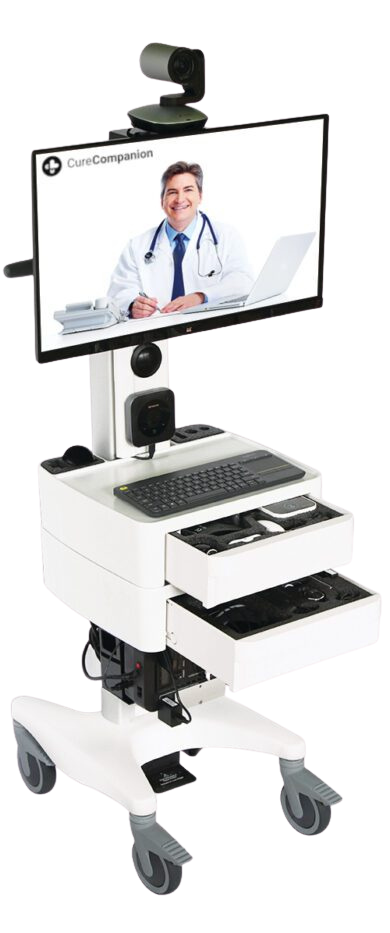
Telemedicine Cart
Hospital-grade telemedicine workstation for the emergency department, inpatient units, and exam rooms.
PC with 27-inch 1080p display, wireless keyboard and touchpad
Pan-tilt-zoom 1080p HD camera; conference-grade speaker and microphone with echo cancellation
Medical-grade battery backup (UPS) and pneumatic height adjustment
Medical devices configured per facility: stethoscope, exam camera, otoscope, 12-lead ECG, vitals devices, spirometer, ultrasound
Also available without medical devices for video-only tele-specialty programs
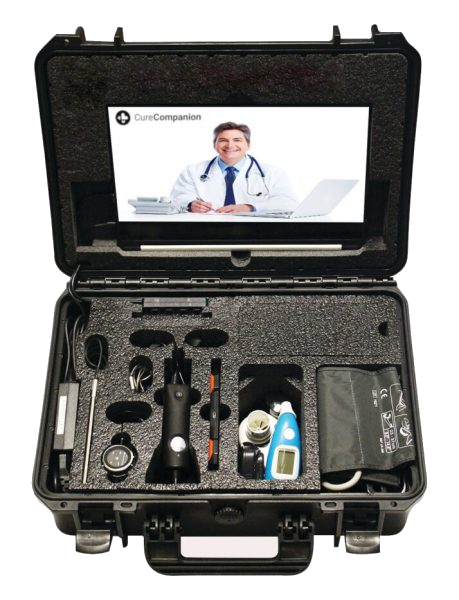
Telemedicine Kit
The same exams in a lightweight case for satellite clinics, schools, EMS, and home visits.
14-inch touchscreen tablet with 1080p HD webcam
Rugged IP-67 dust-proof and water-proof hard case
8+ hour battery life; about 20 lb packed
Same device menu as the cart: stethoscope, exam camera, otoscope, 12-lead ECG, pulse oximeter, blood pressure monitor, glucometer
Arrives pre-connected and tested, with remote training for each team
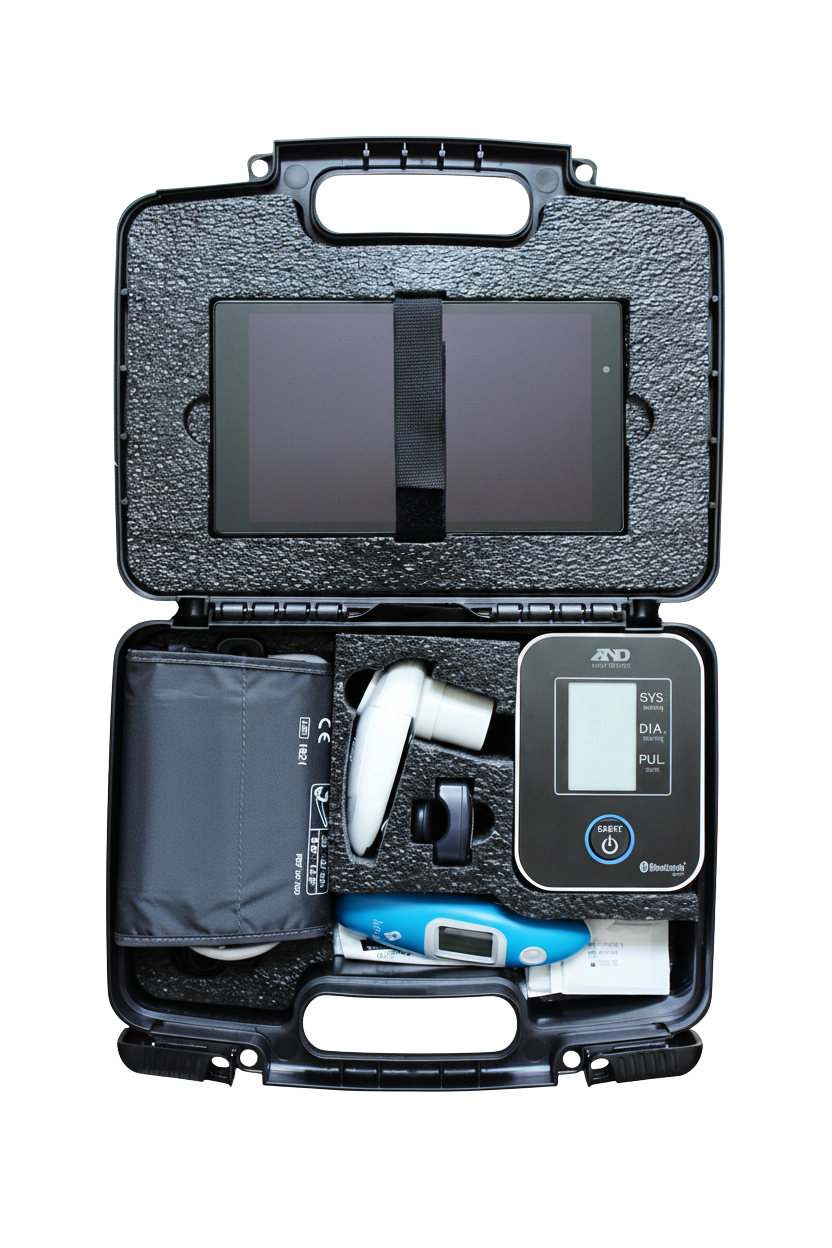
Remote Patient Monitoring Kit
Home vitals for chronic disease management, on the same platform as the visits.
7-inch cellular tablet with a three-button patient app and data plan
Bluetooth blood pressure monitor, pulse oximeter, glucose meter, and weight scale, as needed
Readings flow to the care-team dashboard with alerts for follow-up
Reusable: your staff reprocess and reissue kits to the next patient
Works with our home kit or devices you already own
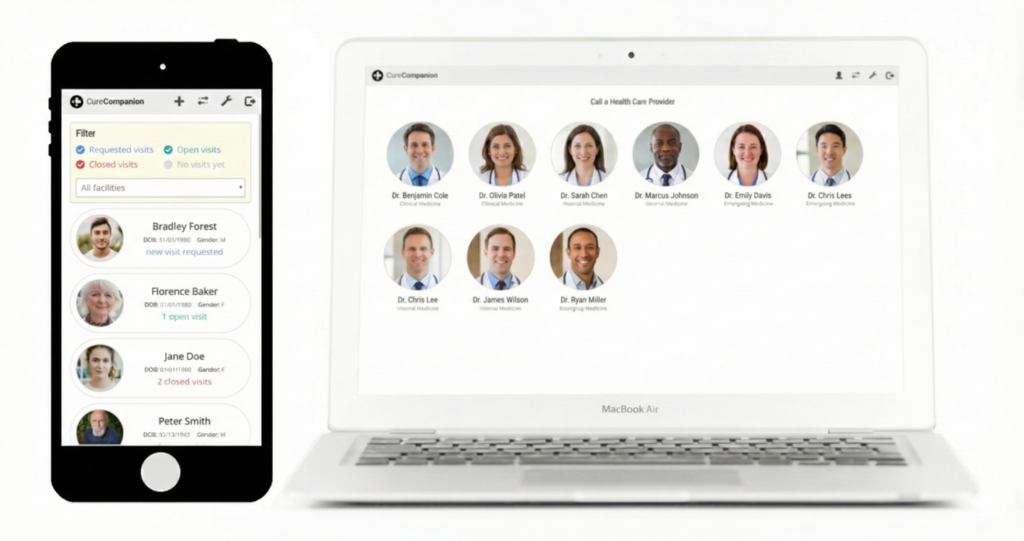
Telehealth Software Platform
One HIPAA-compliant platform for visits, monitoring, records, and AI documentation.
HD video visits on iOS, Android, PC, and Mac: instant, scheduled, and nurse-assisted
One click to enable the exam camera, otoscope, and stethoscope in the visit; Bluetooth vitals and ECG recorded with no manual entry
Patient records, scheduling, secure messaging, and e-signature
AI documentation available: ambient listening drafts the note; post-visit assessments measure outcomes
EHR integration via SMART on FHIR and PointClickCare; white label option
Devices we integrate, by brand: Riester digital stethoscope, Firefly Global video otoscope, SmartHeart 12-lead ECG, A&D Medical blood pressure monitor, Nonin pulse oximeter, Vitalograph spirometer, JEDMED multi-specialty scope, and Butterfly Network handheld ultrasound, plus a handheld exam camera, professional glucometer, and non-contact thermometer. We integrate third-party medical devices; we do not manufacture them. All telehealth equipment and devices →
Match the equipment to the project
Critical access or rural hospital: ED and inpatient tele-specialty
Telemedicine cart in the emergency department and on the nursing unit for tele-stroke, cardiology, pulmonology, and hospitalist coverage. Telehealth for rural and community health →
(D), (F)
Rural health clinic or FQHC
Cart at the main site; kits at satellite sites and for home visits.
(D), (F)
EMS and community paramedicine
Kits in the field for remote consults; RPM kits for patients after discharge.
(A), (D)
Chronic disease management at home
RPM home kits with telemedicine visits on the same platform. Remote patient monitoring →
(A), (C)
School-based health
Telemedicine kit with the school nurse presenting the student. Telehealth for schools →
(D)
AI documentation across all of the above
Ambient listening and facility-defined post-visit assessments, available on the platform.
(D), (F)
What we provide to RHTP applicants and sub-awardees
Included with every quote, in the format your state’s application asks for.
With every quote
Ask for any of these when you request a quote.
Itemized quotes and specification sheets in your application’s format
Equipment descriptions and budget-justification language for the narrative
Sustainability framing for reviewers: owned hardware, one license per organization, reusable RPM kits
Pricing held through your grant cycle
Non-debarment attestation and W-9 on request
A vendor letter for your application on request
Working with us on your RHTP application
Tell us the track, the sites, and the exams
Which state program or track you are applying to, how many sites, which exams and specialties, and whether patients will be monitored at home.
We send an itemized configuration
An itemized quote and specification sheets for each cart, kit, RPM kit, and the software license, with lead times.
We support the narrative
Equipment descriptions, budget-justification language, and sustainability framing you can paste into the application.
Attestations, then delivery
Non-debarment attestation and a vendor letter on request, with pricing held through the cycle. After award, systems arrive pre-connected and tested, with remote training for each team.
Why RHTP applicants work with CureCompanion
Since 2015
One of the first companies to build telemedicine carts and kits, based in Austin, Texas.
20+ states
Rural and community health customers across the United States, plus 12+ countries.
Grant-ready
Vendor to USDA DLT, state telemedicine grant, and RHTP-funded programs, with quotes and specifications built for applications.
One vendor
Accountable for the hardware, the software, a 12-month warranty, and remote training and support.
RHTP telehealth, remote patient monitoring, and AI FAQ
The questions applicants and sub-awardees ask before they request a quote.
Can RHTP funds pay for telehealth equipment and software, and under which allowable uses?
The statute’s allowable uses include consumer-facing technology for chronic disease (C), technology-enabled care in rural hospitals including remote monitoring and artificial intelligence (D), and software and hardware for information technology advances (F), with prevention and chronic disease management (A) served by remote monitoring. Whether a specific purchase is allowable is decided by your state’s program and sub-award terms, so confirm with the state office. We supply the quotes, specifications, and descriptions your application needs.
Is CureCompanion an approved RHTP vendor?
CMS does not approve or certify vendors for the program. Sub-awardees buy under their own procurement rules and the terms of their state award, which can include state purchasing contracts. We are a vendor to RHTP-funded programs and to USDA DLT and state telemedicine grant recipients, and we provide the documentation your procurement review asks for.
What vendor paperwork do grant offices ask for?
Typically an itemized quote and specification sheets, a W-9, and confirmation that the vendor is not suspended or debarred, which we provide as a signed attestation. Some offices also ask for a vendor letter describing the equipment and the support that comes with it. Tell us what your office needs and we will send it with the quote.
Do we need carts, or are kits enough?
Kits cover primary-care exams at satellite clinics, schools, and homes: stethoscope, exam camera, otoscope, and Bluetooth vitals in a 20 lb case. An emergency department or inpatient unit usually needs a cart: a 27-inch display and PTZ camera at the bedside, battery backup, and room for 12-lead ECG, spirometry, and ultrasound. Most hospital projects pair one or two carts with kits for the outlying sites, all on the same platform.
Can we start with one component and add the rest later?
Yes. Carts, kits, RPM kits, and the software are quoted separately and can be phased across budget periods. The software license is per organization, so adding carts, kits, or sites later does not add licenses, and remote patient monitoring works with our home kit or devices you already own.
Do you provide clinicians?
No. We provide the platform and the equipment; your clinicians and the specialists you partner with deliver the care. The workflows are designed for a nurse or medical assistant presenting the patient on site and a provider joining remotely.
What happens when the grant period ends?
You keep the equipment. Hardware is purchased outright with no recurring hardware charges, RPM kits are reissued to new patients, and the software continues under the same per-organization license. That is the sustainability case reviewers ask for, and we write it into the budget-justification language we provide.
Can RPM kits be reused for new patients?
Yes. When a patient completes the program, your staff reprocess the kit per your infection-control protocol and issue it to the next patient. Kits are bought once; how many patients each one serves over the grant period and after is up to your program.
Is AI documentation included?
AI documentation is available on the platform as an option. Ambient listening drafts the progress note from the visit conversation, and facility-defined post-visit assessments measure the outcomes your program reports on. It runs under the same HIPAA controls and Business Associate Agreement as the rest of the platform.
How quickly can equipment arrive after award?
Typical lead time is 4 to 6 weeks after order, with systems arriving pre-connected, configured, and tested. States set obligation and spending deadlines for each budget period, so tell us your dates and we will confirm lead times on the quote.
Request a quote for your RHTP application
Tell us your state’s program or track, your sites, the exams and monitoring you plan, and your deadlines. We will reply with an itemized configuration, specification sheets, and budget-justification language, and a demo if you would like to see the equipment in use.
Itemized quote and specification sheets for your configuration
Budget-justification and sustainability language for the narrative
Live demo of the cart, kit, or remote monitoring workflow
Typical lead time of 4 to 6 weeks after order
Prefer to talk? Call (512) 967-0664 or email contact@curecompanion.com.