
Digital stethoscope
Full 20 to 2,000 Hz auscultation range, powered from the cart over USB with no batteries or buttons. The provider hears heart and lung sounds live at the bedside, and sounds can be recorded for review.
Streams live in the visitCureCompanion’s telemedicine cart is an integrated hardware and software solution that allows medical staff to connect virtually with healthcare providers. Configurable with a wide range of HD cameras and hospital-grade medical devices, our telemedicine cart enables providers to not only see and talk to the patient, but also perform virtual medical exams.
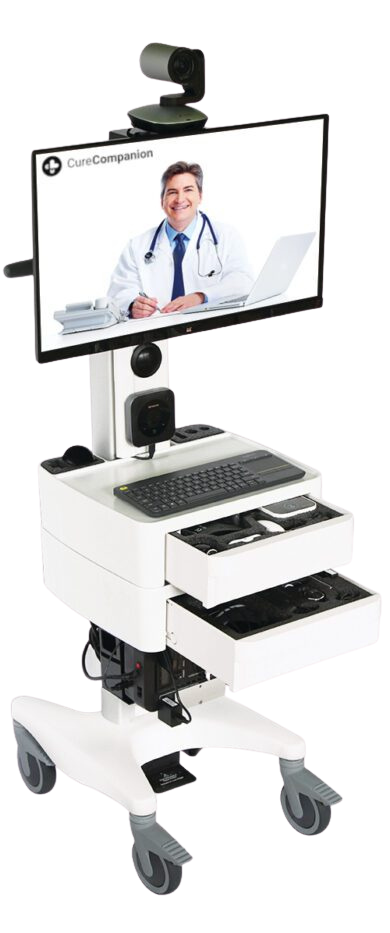





The cart arrives pre-connected, configured, and tested, and runs from a standard outlet on your existing network, with no dedicated circuit or static IP. The workstation is not locked down to our software: your EHR, imaging, and other clinical applications can run on it too.
A large display with a wireless keyboard and touchpad, so the patient sees the provider clearly and staff run the visit at the cart.
Pan, tilt, and zoom with far-end camera control, so the remote provider frames the patient and the room without asking staff to move the cart.
Speaker and microphone with echo cancellation, sized for an exam or consult room, so both sides hear each other without a headset.
An uninterruptible power supply keeps the workstation and devices running while the cart is unplugged and rolled to the next room.
Set the display and camera to the right height for a bedside, chairside, or standing exam on a robust, lightweight rolling cart.
Digital stethoscope, video otoscope, handheld exam camera, 12-lead ECG, blood pressure monitor, pulse oximeter, spirometer, glucometer, and thermometer, configured per facility. Also available without medical devices for video-only programs.
See the devices →With a basic video platform, the remote provider has only the patient's own description to go on. With the cart at the bedside, a nurse or medical assistant operates the devices while the provider examines the patient's skin, eyes, ears, and throat, listens to heart and lung sounds, and gets vitals and a 12-lead ECG in real time.
The cart runs on battery backup while it moves, then plugs into a standard outlet. It joins your network like any other workstation.
A nurse or medical assistant signs in on the cart and starts the video visit. The provider joins from a browser or the mobile app and takes control of the PTZ camera.
Staff switch to the stethoscope, otoscope, or exam camera and the provider sees and hears live. Blood pressure, oxygen saturation, spirometry, and the 12-lead ECG sync into the record over Bluetooth, without manual entry.
Images, sounds, and readings stay with the patient record. AI documentation that drafts the note is available on the platform, and your EHR can run on the same workstation.
Patient and room view
A fixed webcam wherever the laptop happens to sit.
A PTZ camera the provider pans, tilts, and zooms, with room-filling audio.
Skin and wounds
Held up to the webcam, with lighting and angle set by the patient.
Handheld exam camera with adjustable LEDs and close focus, streamed live.
Ears, nose, and throat
Not examinable; the patient describes the symptoms.
Video otoscope streams the ear canal, eardrum, nose, and throat in HD.
Heart and lungs
The patient reports how they feel.
Digital stethoscope streams heart and lung sounds for live auscultation.
Vital signs and ECG
Readings typed in from a separate monitor, if there is one.
Blood pressure, pulse oximetry, temperature, spirometry, and a 12-lead ECG captured at the bedside; Bluetooth readings go straight into the record.
Workflows are modeled on in-person visits, so staff run the cart after a 60 to 90 minute remote training session, and your own providers and partner specialists see the patients.
The cart ships with the full device set below, configured per facility; devices can be added or removed, and the cart is also available without medical devices for video-only programs. USB devices stream live in the video visit, and Bluetooth devices send readings into the patient record without manual entry.
Full 20 to 2,000 Hz auscultation range, powered from the cart over USB with no batteries or buttons. The provider hears heart and lung sounds live at the bedside, and sounds can be recorded for review.
Streams live in the visitHD video otoscope with dual lenses, three-layer glass, and adjustable ultra-bright LEDs for ear, nose, and throat exams, streamed live to the provider.
Streams live in the visitEight brightness-adjustable LEDs and 10 to 500 mm focus for skin, wound, throat, and dental views at 1280×720, streamed live.
Streams live in the visitHospital-grade 12-lead ECG in about 30 seconds with guided electrode placement, operated by on-site staff. The tracing lands in the visit record.
Bluetooth, no manual entryClinically validated upper-arm monitor. Readings sync into the visit over Bluetooth LE while the provider watches.
Bluetooth, no manual entrySpO₂ and pulse rate across a wide range of patients and settings, synced into the visit record.
Bluetooth, no manual entryFEV1, FEV6, and FEV1/FEV6 for COPD, asthma, cystic fibrosis, and post-transplant monitoring, read wirelessly into the record.
Bluetooth, no manual entryPoint-of-care blood glucose in seconds from a small fingerstick sample, built for multi-patient use. Results are entered into the visit.
Manual entryForehead temperature without contact for every visit. The reading is entered into the visit.
Manual entryThe cart is sold with the CureCompanion platform, the same software that runs our telemedicine kits and remote patient monitoring. It drives the devices during the visit, keeps the record, and connects to your EHR. Because the workstation is open, your other clinical software runs on the cart as well.
Encrypted video visits on web, iOS, and Android, with far-end control of the cart's PTZ camera.
One-touch device switching: activate the stethoscope, otoscope, or exam camera and the software detects it and streams it to the provider.
Bluetooth vitals and the 12-lead ECG write into the patient record without manual entry.
Patient records, visit notes, progress notes, and digital prescriptions in one place.
Email and SMS notifications and an admin dashboard.
EHR integration via SMART on FHIR and PointClickCare.
AI documentation that drafts the note from the visit conversation, and facility-defined post-visit assessments, available on the platform.
White label: deploy the software under your own brand, fully operated and supported by us.
Workflows are modeled on in-person visits. Remote training runs 60 to 90 minutes per team, with refreshers available, and your own providers and partner specialists see the patients.
HIPAA compliant with a Business Associate Agreement: AES-256 encryption at rest, TLS 1.2+ in transit, access controls, audit logging, and automated daily backups.
One license per organization covers telemedicine carts, kits, and remote patient monitoring. Add kits for satellite sites or home kits later and they share the same patient record.
The same cart serves inpatient units, exam rooms, and nursing facilities. Each gets a full exam, the same software, and one vendor for warranty and support.
Bring a remote specialist to the bedside for tele-stroke, cardiology, pulmonology, and hospitalist coverage, with the exam devices and a 12-lead ECG at hand.
Specialist consults without a transfer, and after-hours coverage for a small inpatient census. We supply carts to rural hospitals funded by USDA DLT, state grants, and RHTP.
Telehealth for rural and community health →After-hours change-in-condition assessments and weekend coverage without transportation, with PointClickCare integration for the record.
Telemedicine for skilled nursing →A shared cart serves several exam rooms at a health center or FQHC, bringing specialists to the main site while kits cover the satellite sites.
Specialist consults on demand for the cases that would otherwise be referred out, with the PTZ camera and exam devices in the room.
A cart in a school-based health center connects students to providers during the school day, with ears, throat, lungs, and vitals examined on the spot.
Telehealth technology for schools →Many programs pair carts at the main site with telemedicine kits at satellite sites, schools, and in the field, all on one software license and one patient record.
Three ways to put the same software and devices to work. Most programs mix them: carts at the main site, kits wherever the visit moves.
Best for
Cart: inpatient units, emergency departments, nursing facilities, and facility-based exam rooms.
Kit: satellite sites, schools, home visits, vans, and anywhere the visit moves.
Starter: a low-cost first step on computers you already own.
Display and camera
Cart: 27-inch 1080p display, pan-tilt-zoom 1080p camera with far-end control, conference-grade speaker and microphone.
Kit: 14-inch touchscreen tablet with 1080p HD webcam.
Starter: your own PC, laptop, or mobile device, plus an HD webcam and speakerphone.
Medical devices
Cart: nine integrated devices, from the digital stethoscope and otoscope to the 12-lead ECG and spirometer, configured per facility; also available without medical devices for video-only programs.
Kit: the same nine-device menu in a portable case, configured per program.
Starter: digital stethoscope, video otoscope, and handheld exam camera.
Power and mobility
Cart: medical-grade battery backup (UPS), pneumatic height adjustment, rolling cart built for hospital use.
Kit: 8+ hour battery, IP-67 rated hard case, 20 lbs.
Starter: 12-inch hard case with cut foam; powered by your computer.
Software
Cart: CureCompanion platform, licensed per organization; the cart is an open workstation your other clinical software can run on.
Kit: same platform and license.
Starter: same platform, on the starter plan.
The cart is the full exam room on wheels for inpatient units, emergency departments, and exam rooms. Compared to other telemedicine carts, ours is more cost-effective and delivers a more complete exam. The kit brings the same exam devices to satellite sites and the field at lower hardware cost, and the starter kit is devices and accessories for computers you already own.
A cart per unit, emergency department, or clinic site is a common equipment line in telehealth grant budgets. We supply equipment to USDA DLT grant recipients and state telemedicine programs, and we work with organizations putting Rural Health Transformation Program funds to work.
Delivery
The cart arrives pre-connected, configured, and tested, typically 4 to 6 weeks after order.
Training
Remote, 60 to 90 minutes per team, with refreshers available.
Power
A standard 120 V grounded outlet drawing under about 3 amps; no dedicated circuit. Battery backup covers moves between rooms.
Network
About 1 Mbps per visit, 4 to 5 Mbps recommended, over your existing wired or Wi-Fi network; no static IP.
Footprint
About 24 by 24 inches and 60 inches tall, with pneumatic height adjustment and a robust, lightweight rolling frame.
Warranty and support
12-month warranty on the cart and integrated peripherals, with email and phone support.
Ownership
Hardware is purchased outright with no recurring hardware charges. Software is licensed per organization, not per cart or per user.
Rural Health Transformation Program (RHTP). CMS's five-year program funds all 50 states, which sub-award to rural providers. Its infrastructure and technology priority covers equipment and telehealth, and telemedicine workstations that bring remote specialists to the emergency department and inpatient units sit squarely in it. How we fulfill RHTP telehealth, RPM, and AI expectations →
USDA Distance Learning and Telemedicine (DLT). We have responded to DLT equipment bids and delivered systems to DLT grant recipients, with the itemized quotes, specification sheets, and equipment descriptions a budget justification needs.
State and foundation grants. State telemedicine grants and foundation awards look for a sustainable program and equipment that keeps working after the grant ends: hardware owned outright and one software license per organization.
Itemized quotes and specification sheets in the format your application requires
Equipment descriptions and budget-justification language
Pricing held through your grant cycle
Sustainability framing for reviewers: outright hardware purchase and one software license per organization
Designing, integrating, and supporting telemedicine systems from Austin, Texas.
Customers across 20+ states and 12+ countries, from hospitals and skilled nursing facilities to community health centers and schools.
Vendor to USDA DLT, state telemedicine grant, and RHTP-funded programs, with the paperwork their applications need.
Hardware, software, 12-month warranty, remote training, and support from the same team.
The questions hospitals, nursing facilities, clinics, and grant applicants ask before they request a quote for a cart.
A telemedicine cart is a mobile workstation that brings a remote provider to the patient: a large display and camera, room audio, a computer, and integrated medical devices such as a digital stethoscope, otoscope, exam camera, 12-lead ECG, and vitals monitors, all driven by telehealth software. The CureCompanion cart is a rolling workstation built for hospital use, with a 27-inch display, PTZ camera, battery backup, and nine integrated devices.
A 27-inch 1080p display with wireless keyboard and touchpad, a pan-tilt-zoom 1080p HD camera with far-end control, conference-grade speaker and microphone, medical-grade battery backup, pneumatic height adjustment, and nine integrated medical devices: digital stethoscope, video otoscope, handheld exam camera, 12-lead ECG, blood pressure monitor, pulse oximeter, spirometer, glucometer, and non-contact thermometer. Carts are built to order; devices can be removed or added, and a video-only configuration is available.
A cart is the choice for inpatient units, emergency departments, nursing facilities, and exam rooms where the visit comes to a fixed station: large display, PTZ camera, battery backup, and height adjustment at the bedside. A kit packs a tablet, webcam, and the same devices into a 20 lb case for satellite sites, schools, and home visits. Both run the same software, and many programs use both.
Yes. The cart's workstation is not locked down to our software, so your EHR, imaging viewer, and other clinical applications can run on it alongside the CureCompanion platform.
A standard 120 V grounded outlet drawing under about 3 amps, so no dedicated circuit, and your existing wired or Wi-Fi network at about 1 Mbps per visit, with 4 to 5 Mbps recommended. No static IP is required. Battery backup keeps the cart running while it moves between rooms.
A nurse or medical assistant at the bedside runs the devices while the remote provider directs the exam and controls the camera. Workflows are modeled on in-person visits; training is remote and usually takes 60 to 90 minutes per team, with refreshers available.
Yes. The PTZ camera has far-end control, so the provider pans, tilts, and zooms from their own screen to frame the patient, a wound, or the room, without asking staff to move the cart.
Video, images, sounds, and readings travel through the CureCompanion platform, which is HIPAA compliant: encryption in transit (TLS 1.2+) and at rest (AES-256), access controls, audit logging, automated daily backups, and a Business Associate Agreement.
It depends on the configuration: the devices on the cart, a video-only or full-exam build, and the number of carts and sites. Hardware is purchased outright with no recurring hardware charges, and the software is licensed per organization rather than per cart or per user. Request a quote and we will itemize a configuration for your program and budget.
Telemedicine carts are a common equipment line in these programs. RHTP's infrastructure and technology priority names telehealth and other digital tools, USDA DLT grants have funded telemedicine carts and kits for years, and state telemedicine grants follow the same pattern. Eligibility and allowable costs are decided by the program and your state; we supply the quotes and specifications your application needs. Our RHTP telehealth, RPM, and AI guide →
Tell us your sites, the exams you need, and how many carts. We reply with:
An itemized quote and specification sheet for your cart configuration
Budget-justification language for grant applications
A live demo of a cart visit, with the devices streaming and the PTZ camera under the provider's control
Lead time and a training plan for your teams
Prefer to talk? Call (512) 967-0664 or email contact@curecompanion.com.